Check claims with a cheap model after a rewrite
Checking claims against a source doesn't have to use the biggest model. A new paper got close to a frontier model's accuracy for about half the cost.
The task is fact-checking peer review comments, which sometimes misstate what a paper says, whether a human or an AI wrote them. The authors built a benchmark, ReviewFact, and a framework called PremiseCheck (Lehigh and UBC authors).
There are two ways to check a comment. A frontier LLM does it well but has to read the whole paper every time. Cheap 'decision models', which score whether a statement holds in a given text, are fast but struggle with a long comment that packs several claims into one sentence.
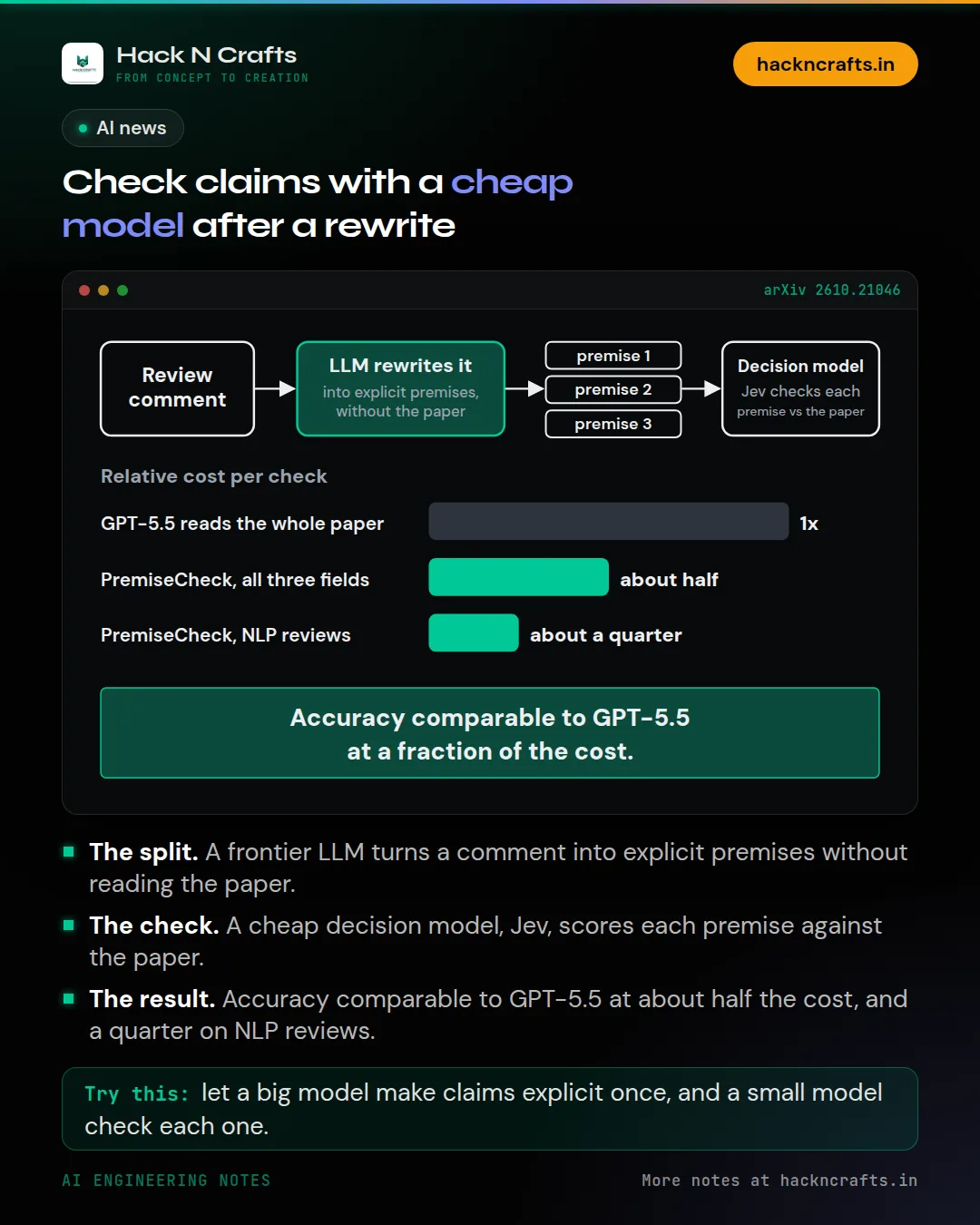
PremiseCheck combines them. First an LLM rewrites each comment into explicit premises, without reading the paper. Then a decision model checks each premise against the paper. In the paper's setup the LLM is GPT-5.5 and the decision model is Jev.
Reported result: accuracy comparable to GPT-5.5 across all three fields at about half the cost, and on NLP reviews at a quarter of the cost and under half the latency.
The pattern travels. If you verify AI output at scale, split the work: let a big model make the claims explicit once, and let a small, cheap model check each one.
Where in your pipeline are you paying frontier prices for a checking job?
Sources
New notes go out on LinkedIn first. Building something with AI? We can help.