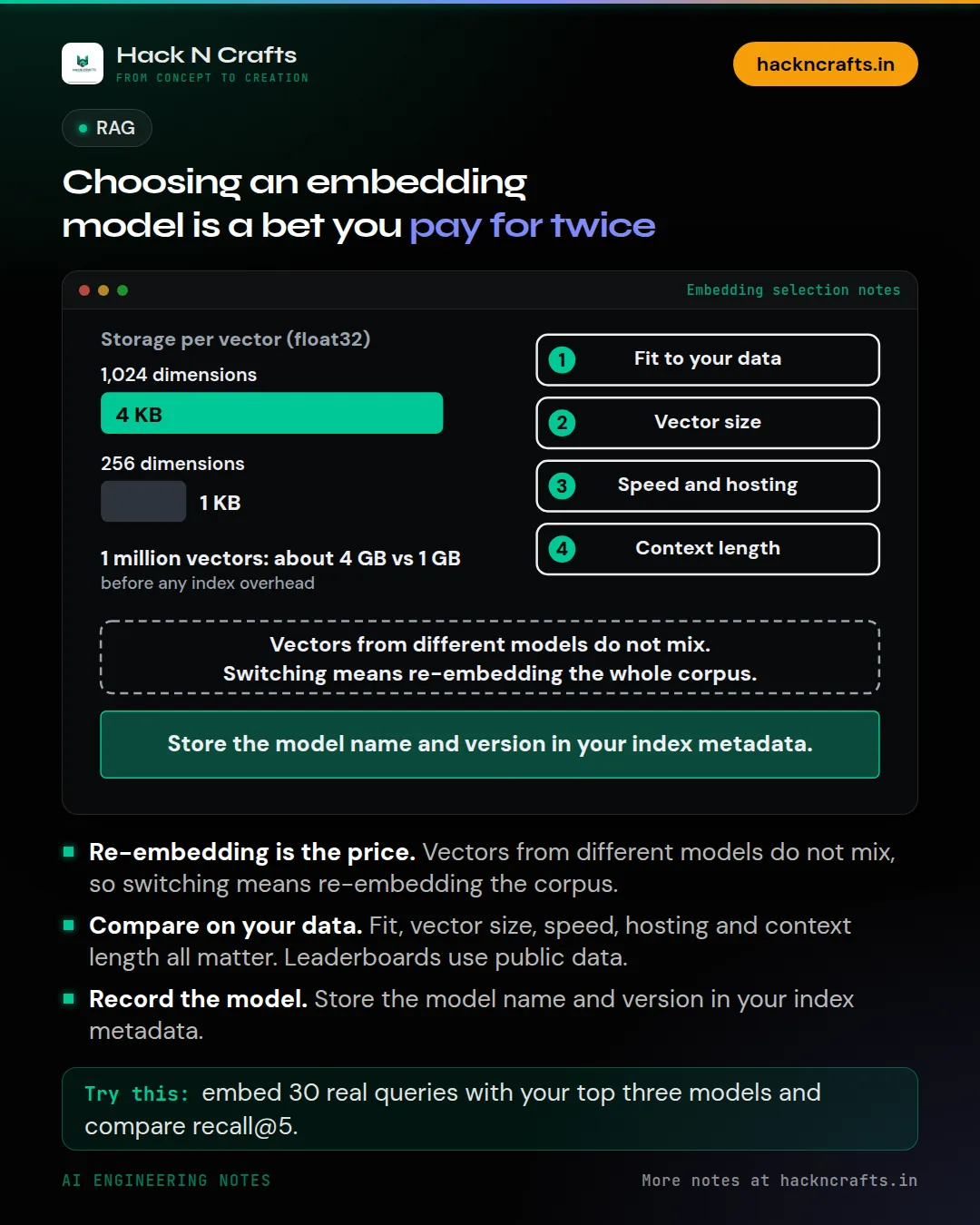
Choosing an embedding model is a bet you pay for twice
Choosing an embedding model is a bet you pay for twice: when you index, and again when you change your mind.
Changing models means re-embedding your whole corpus, because vectors from different models don't live in the same space. For a big index that's real time and money. So choose with care, and test before you commit.
What to compare:
- 1Fit to your data. Multilingual, code, long documents and short queries behave differently. Public leaderboards use public data, so look at the score that matches yours.
- 2Vector size. A 1,024-dimension index costs far more to store and search than a 256-dimension one. Some models let you truncate vectors with a small quality loss. Measure it.
- 3Speed and hosting. A model you can't run at your query volume, or can't legally send your data to, isn't an option.
- 4Context length. If your chunks are long, check the limit.
Then test on your own questions. Take 30 real queries with labeled answer chunks, embed with your top three candidates, and compare recall@5. The winner on a leaderboard isn't always the winner on your data.
Keep the model name and version in your index metadata. Future you will need it.
Which embedding model are you on, and when did you last compare it to another?
New notes go out on LinkedIn first. Building something with AI? We can help.