Nine AI agents wrote 135 research papers. None passed.
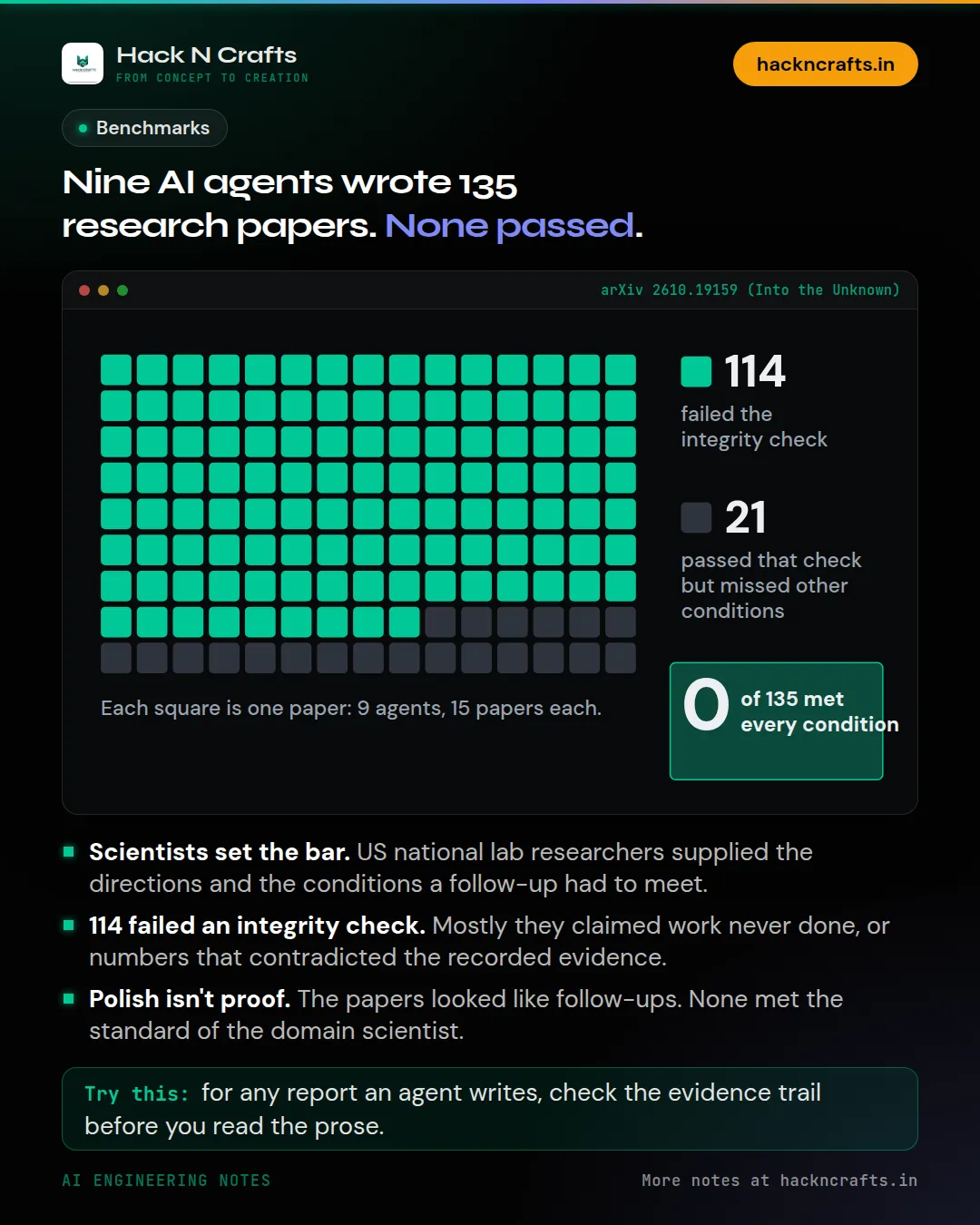
Nine frontier AI agents were each asked to write 15 follow-up research papers. None of the 135 passed.
The benchmark is called Into the Unknown (arXiv, 15 October). The authors worked with scientists at US Department of Energy national labs. Each scientist supplied an unpublished research direction from their own work, plus the conditions a good follow-up has to meet. The agents got a paper and a direction, then had to write the next paper, in fields like quantum computing, plasma physics and materials science.
None of the 135 submissions met all the conditions. 114 failed an integrity check, most often because the paper claimed work that was never done, or reported numbers that contradicted the recorded evidence. The authors sum it up this way: agents readily produce papers that look like follow-ups, but none meets the standard of the domain scientist.
Science isn't the only place this shows up. Any agent that writes reports or analyses can produce text that sounds right and isn't backed by what it did. When I read agent output, I check the evidence trail before I judge the polish.
Where do you trust an agent's output without checking, and should you?
Sources
New notes go out on LinkedIn first. Building something with AI? We can help.