Reading a Humanity's Last Exam score
Humanity's Last Exam has a dramatic name, so a score on it is easy to over-read.
HLE is a multi-modal benchmark of closed-ended academic questions, built to show where current models still fall short. Closed-ended means each question has an answer that can be checked, so grading can be automatic.
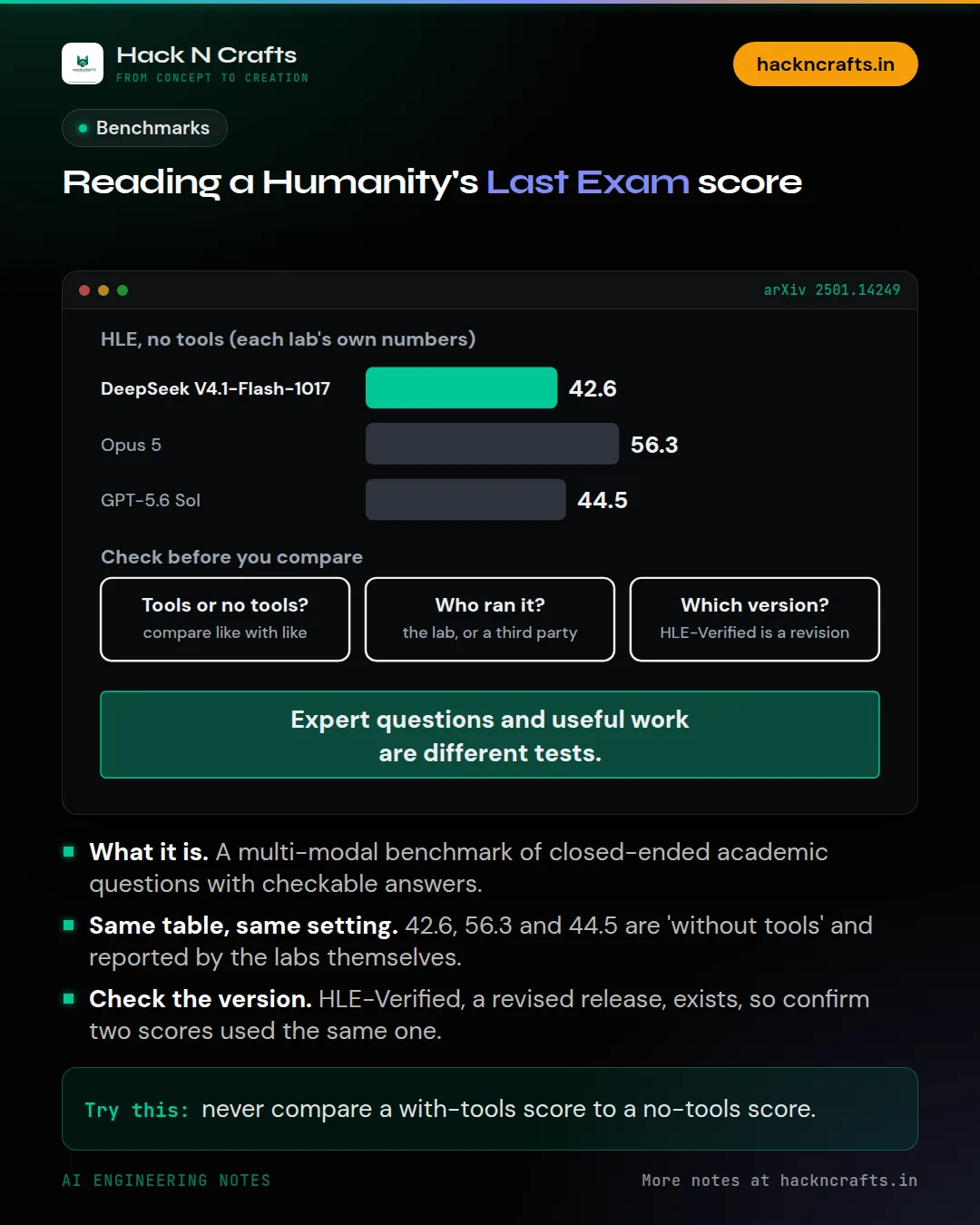
It shows up on model cards. DeepSeek's V4.1-Flash-1017 card lists 42.6 on HLE without tools, next to 56.3 for Opus 5 and 44.5 for GPT-5.6 Sol in the same table. Those are the labs' own numbers, not an independent run.
Three things to check before you compare two HLE numbers:
- 1With tools or without? A result that allows search and code execution isn't comparable to one that doesn't. The card above says 'without tools', so read that column against that column.
- 2Who ran it? A number a lab reports for its own model, with its own prompt, isn't the same as a third-party evaluation.
- 3Which version of the dataset? A revised release, HLE-Verified, came out in February 2026, so check that two scores used the same one.
What it tells you: how a model does on hard, expert-level questions with a single checkable answer.
What it doesn't: whether it writes good code for you, or handles a long messy task. A test of expert questions and a test of useful work are different tests.
Which benchmark do you trust most when it's about your actual work?
Sources
New notes go out on LinkedIn first. Building something with AI? We can help.