What tau-bench measures, and where it misleads
An agent that solves a task once is a demo. One that solves it every time is a product. tau-bench was built to measure that gap.
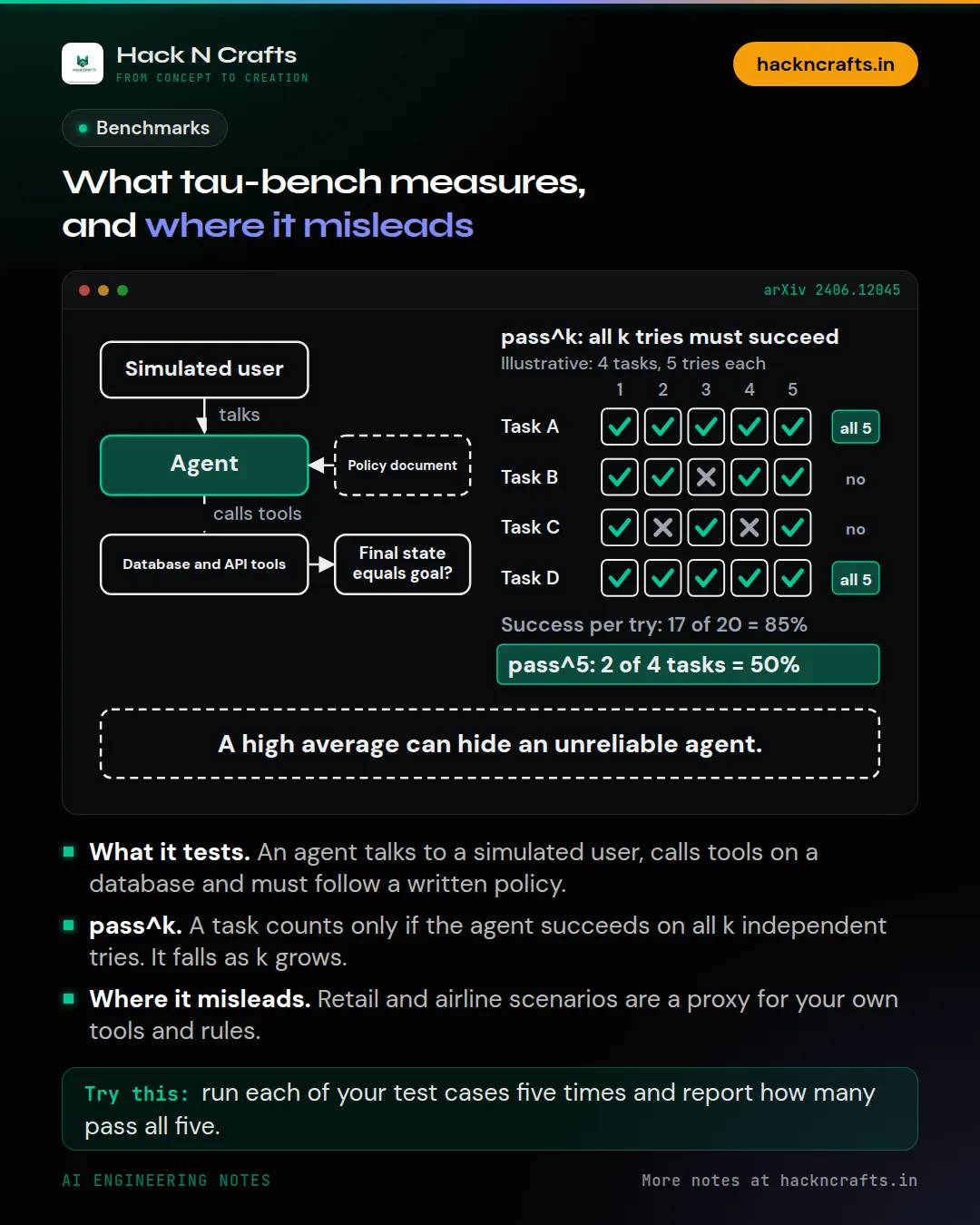
The benchmark puts an agent in a realistic customer-service setting. It talks to a simulated user, calls tools against a database, and has to follow the domain's rules, like a refund policy. The paper's finding is that function-calling agents are inconsistent. In 2024, even gpt-4o succeeded on under 50% of tasks, and on the retail tasks its pass^8 was under 25%. It could pass a task on one run and fail the same task on the next.
That's why it reports a reliability number, pass^k, as well as a plain success rate. Pass^k asks whether the agent succeeds on all k independent attempts at the same task. It falls quickly as k grows, because every extra attempt is another chance to slip.
What it tells you: whether an agent can hold to a policy through a conversation that wanders, with a user who changes their mind.
What it doesn't: how the agent behaves in your domain, with your tools and your rules. The retail and airline scenarios are a proxy.
Borrow the idea. Run each of your test cases five times, and report how many pass all five.
How many of your agent's wins would survive that?
Sources
New notes go out on LinkedIn first. Building something with AI? We can help.