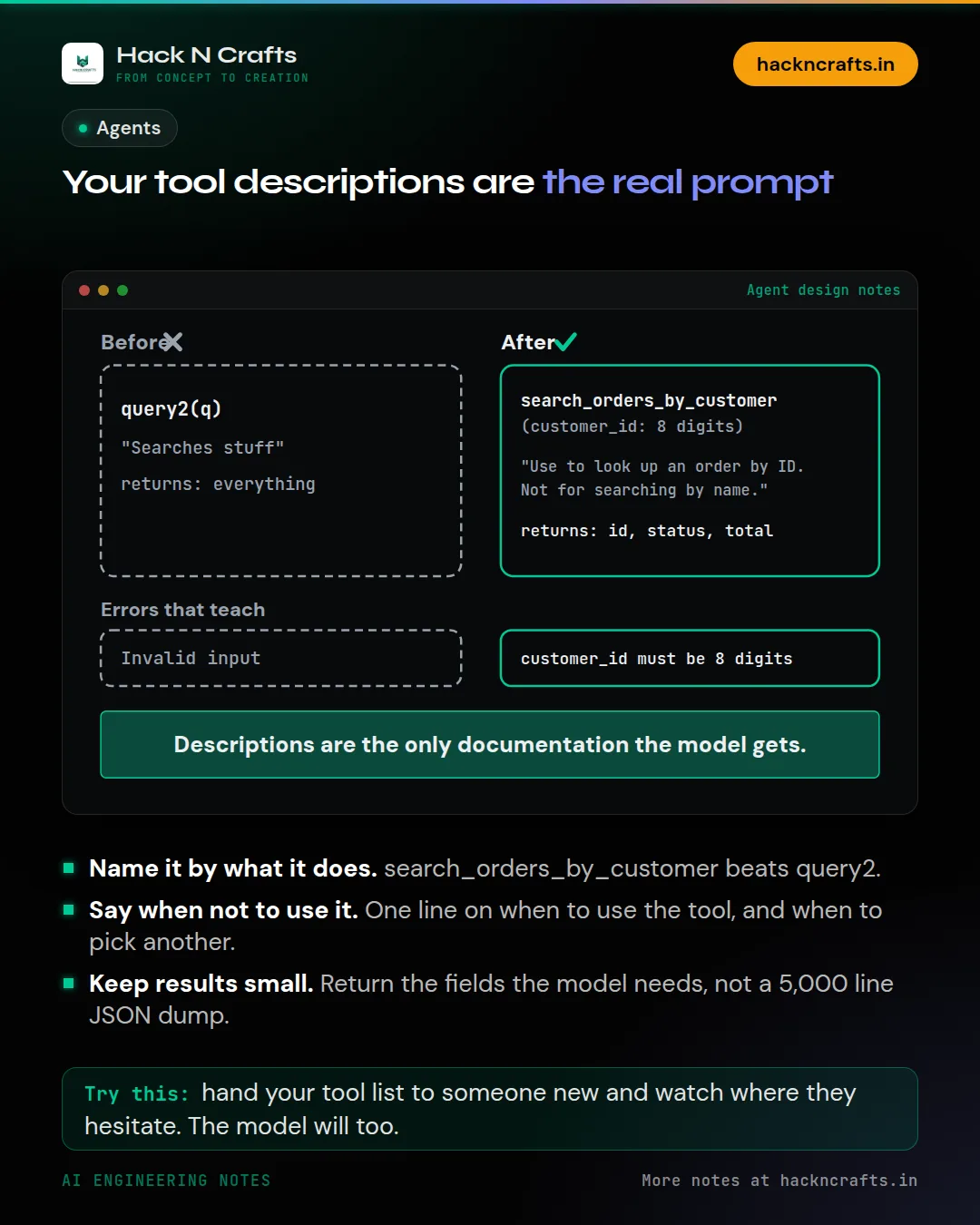
Your tool descriptions are the real prompt
Many agent failures trace back to the tool, not the model. The tool was described in a way the model couldn't use correctly.
A tool description is the only documentation the model gets. Treat it like the docs for a new teammate who can't ask questions.
What helps:
- 1A name that says what it does. search_orders_by_customer beats query2.
- 2A description that says when to use it and when not to. 'Use this to look up an order by ID. Don't use it to search by name.'
- 3Few, clear parameters, with types and an example value for anything ambiguous.
- 4Errors that explain the fix. 'customer_id must be 8 digits' teaches the model. 'Invalid input' doesn't.
- 5Results that are small and relevant. Return the fields the model needs, not a 5,000-line JSON dump.
Also keep the list short. Every tool costs context, and the more look-alike tools you offer, the more often the model picks the wrong one. If two tools overlap, merge them or remove one.
You can test this without a model. Hand the tool list to a person who hasn't seen your system and ask them to complete three tasks. Wherever they hesitate, the model will too.
Which of your tools would confuse a new hire?
#AIAgents#MCP#GenerativeAI#AI
New notes go out on LinkedIn first. Building something with AI? We can help.