GraphRAG pays off for multi-hop questions
GraphRAG is worth the trouble when your questions are about how things connect, not what a passage says.
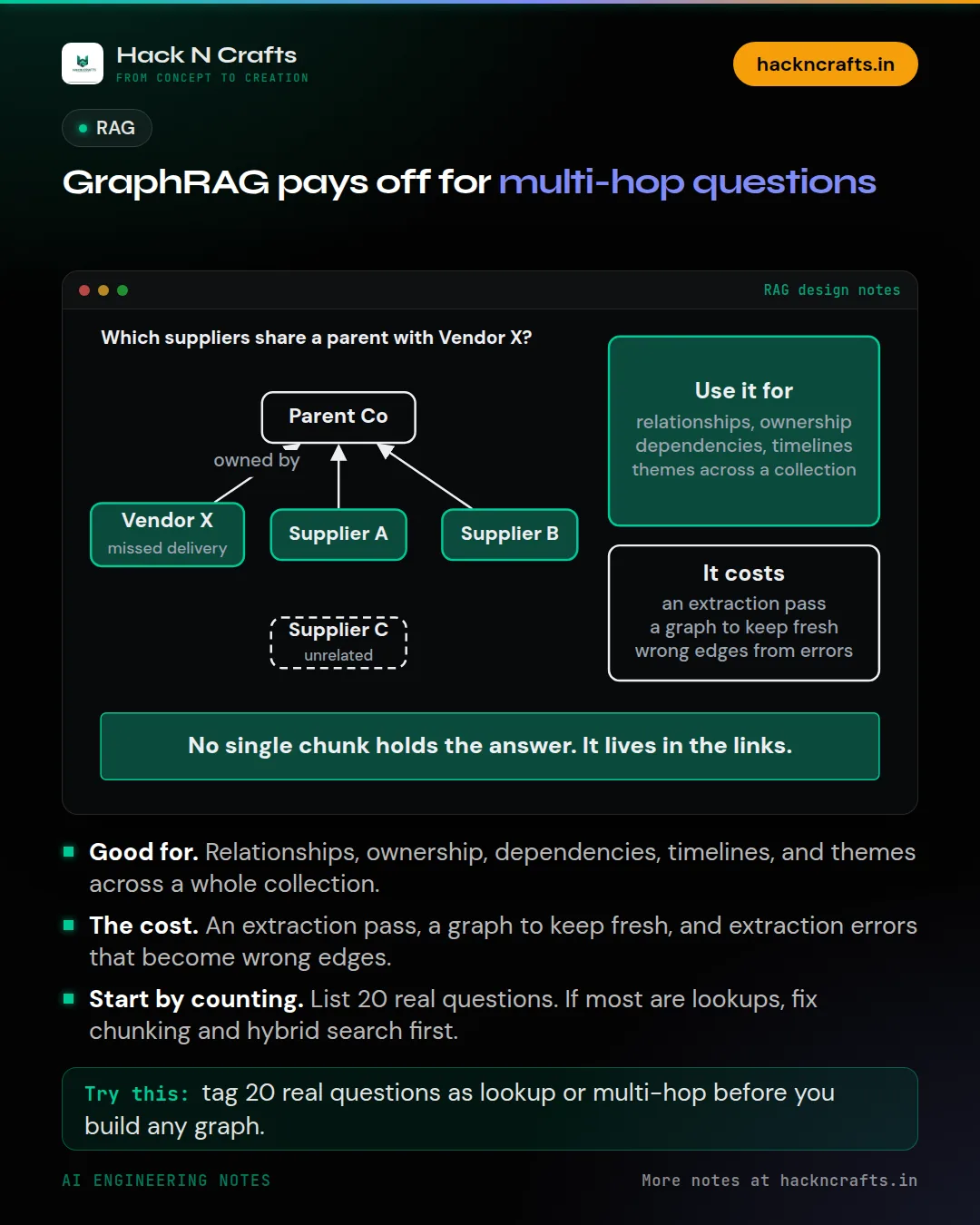
Plain RAG is good at finding a passage that matches a question. It's weak at questions that need several facts joined together. 'Which suppliers share a parent company with the vendor that missed last quarter's delivery?' The answer isn't in any one chunk. It's in the links between them.
GraphRAG adds those links. You extract entities and relationships from your documents, store them as a graph, and at question time you walk the graph to collect connected facts, then hand them to the model.
When it helps:
- 1Questions about relationships, dependencies, ownership or timelines.
- 2Questions that summarize a whole collection, like 'what are the main themes?'
- 3Domains where entities have stable names: people, products, systems, contracts.
What it costs: an extraction pass over your whole corpus, a graph to keep fresh, and extraction errors that become wrong edges. For plain lookups it's usually overkill.
Start by listing 20 real questions. If most are lookups, improve your chunking and hybrid search first. If many are multi-hop, a graph is a real candidate.
What share of your users' questions are multi-hop?
New notes go out on LinkedIn first. Building something with AI? We can help.