Retries should carry evidence, not start over
When a long-running agent fails, the cause is often several steps back. A new paper, BeliefWeaver, tries to fix that by remembering the evidence.
Agents that work for many steps tend to repeat themselves after an early mistake, or commit to a wrong idea they can't easily undo. Reflection and backtracking help, but they work locally. They don't see that two different branches share the same bad assumption.
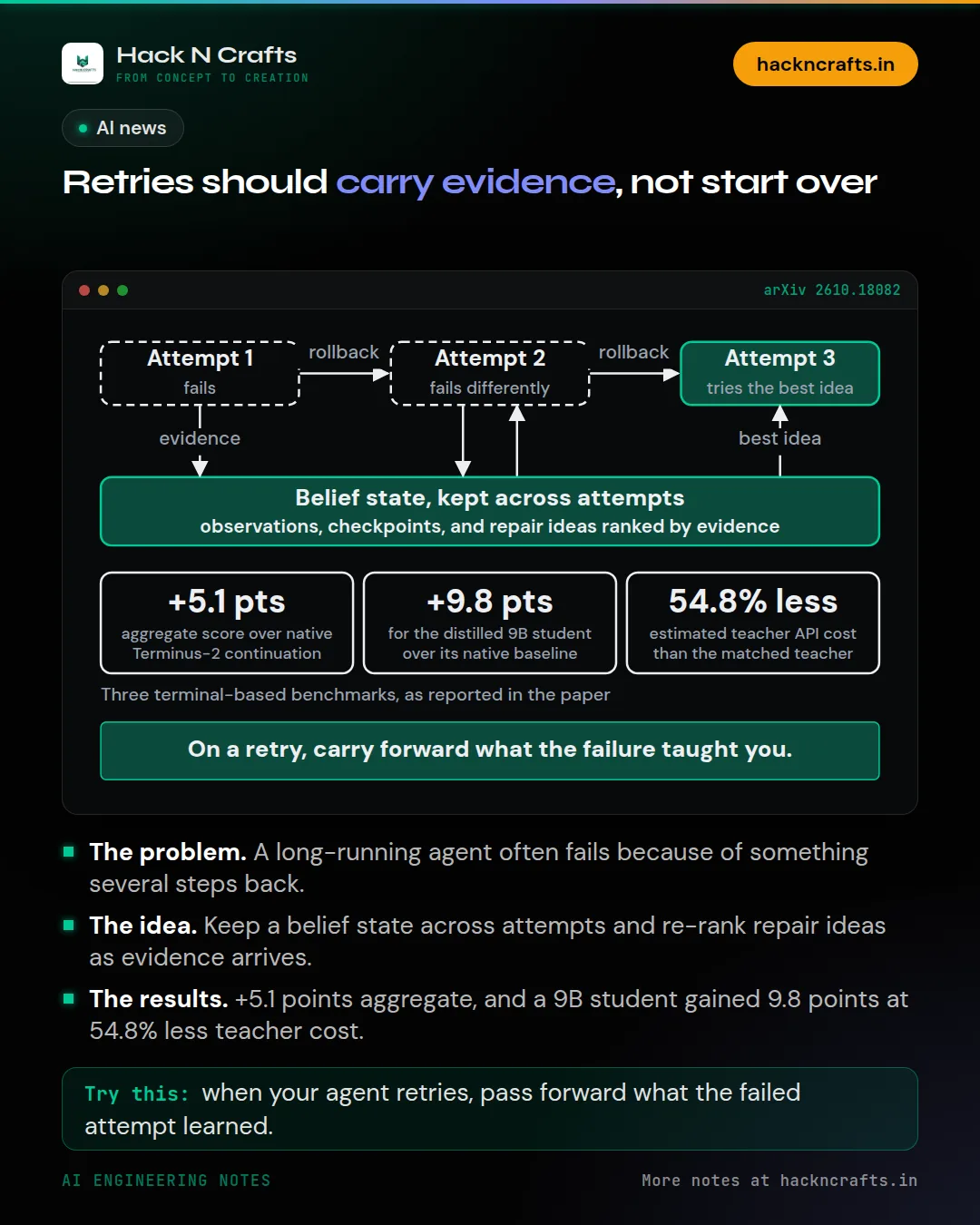
BeliefWeaver (University of Maryland, Google and MBZUAI authors) keeps a persistent 'belief state' across attempts: the candidate fixes it has tried, what it observed, and the checkpoints it can roll back to. Evidence from one attempt updates the priority of related ones. A learned world model scores repair ideas and predicts which are worth trying.
Reported results on three terminal-based benchmarks: a 5.1 percentage point improvement in aggregate final score over the native Terminus-2 continuation. They also distilled the approach into a 9B student, which improved by 9.8 points over the reported native baseline while cutting the estimated teacher API cost by 54.8%.
The takeaway for builders is simple. When an agent retries, don't just rerun it. Carry forward what it learned from the failure.
What does your agent remember between its first attempt and its second?
Sources
New notes go out on LinkedIn first. Building something with AI? We can help.